Questions?
You can get more information on these payment models and request the 2026 AVIP Program Description Guide. Just email Provider Relations.

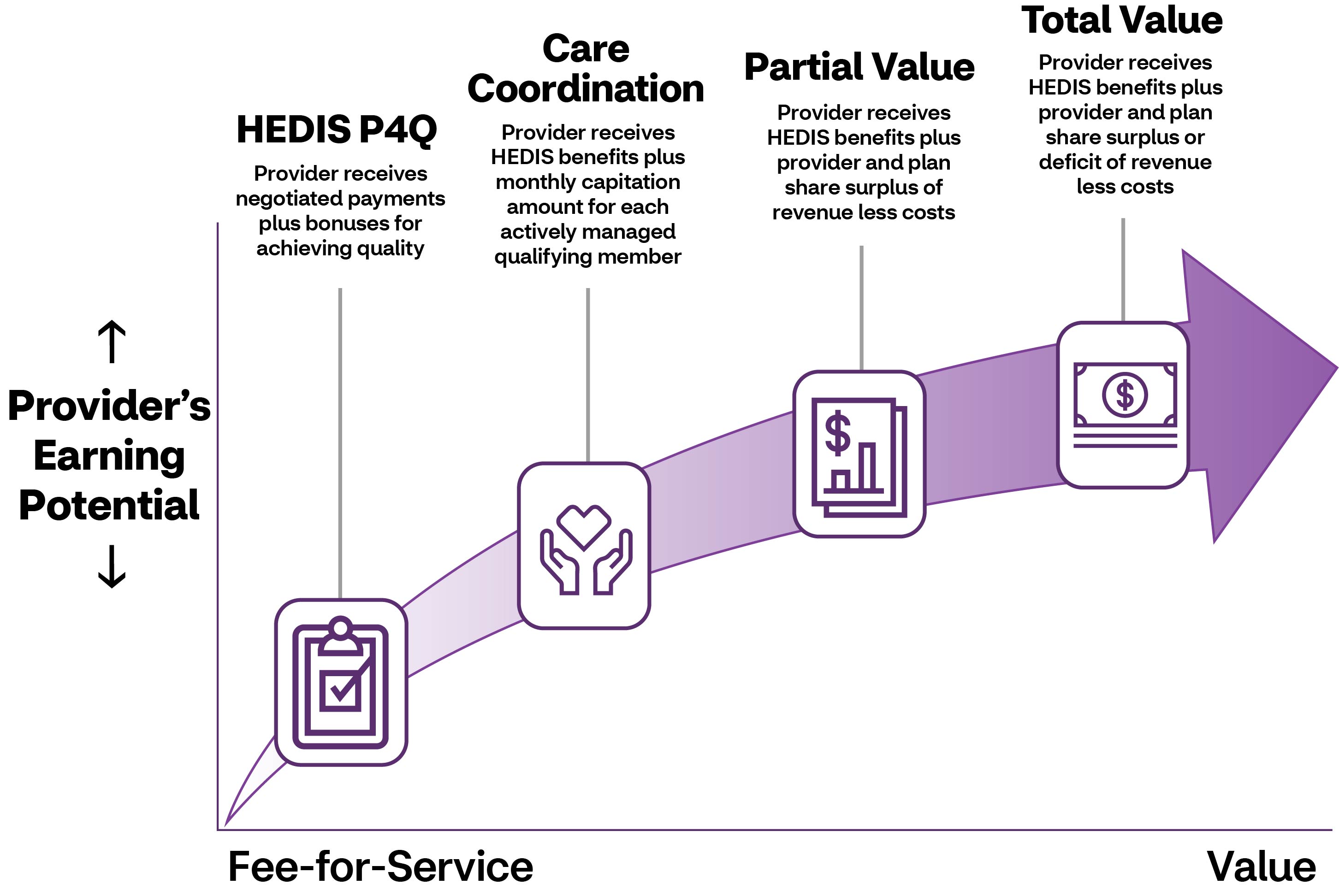
We offer a continuum of value-based care payment models for Medicaid providers to promote excellent health outcomes while achieving additional earnings. Learn how you can earn incentives for providing high-quality, efficient care and can even share financial risk in some.

We’re used to a health care system that takes care of people after they’re already sick. Value-based care (VBC) moves beyond sick care and takes a proactive, comprehensive, data-driven approach to keeping people healthy.
VBC is a health care delivery model that:
The goal of VBC is to:


332 distinct provider groups
Over 90% of membership and 48% of total Medicaid spend by VBC
Over 9,000 providers across all regions of the state
HEDIS is the Healthcare Effectiveness Data and Information Set — standardized performance measures developed by the National Committee for Quality Assurance (NCQA) for the managed care industry. Providers can use HEDIS data to ensure appropriate care for members by identifying and eliminating gaps in care.
We offer our providers the opportunity to take part in our HEDIS Aetna Value Initiative for Providers (AVIP) P4P program. The program has a dynamic payment model that pays providers annual bonuses based on the measures they complete. Each measure has a specific incentive amount paid after a target score is achieved. AVIP P4P enhances quality of care by incentivizing providers to focus on preventive and screening services.
To further encourage preventive care, we give providers the option to take part in partial-value shared savings agreements. Providers who achieve a medical benefits ratio* (also known as medical loss ratio) goal we set are paid part of the surplus related to their assigned members’ cost of care. These agreements incentivize providers to actively engage members in preventive, low-cost outreach and care to prevent high-cost emergency department (ED) visits and inpatient admissions.
Providers who take part in a partial-value-based agreement will have more supports and resources, including robust and regular bi-directional data sharing with us. We expect these providers to progress to total-value-based agreements after one to two years.
The total-value program is the pinnacle of earning opportunities we offer. Providers taking part in total-value-based agreements can earn a greater part of surplus payments than those in partial-value-based agreements, while also being accountable for members’ costs.
Each year, providers in total-value-based agreements are paid part of the surplus or pay us part of the deficit related to their assigned members’ cost of care.
As with partial-value-based agreements, total-value-based agreements incentivize preventive, low-cost outreach and care to prevent high-cost, high-risk ED visits and inpatient admissions. Providers in total-value-based agreements have access to advanced resources, data sharing and reporting.

You can get more information on these payment models and request the 2026 AVIP Program Description Guide. Just email Provider Relations.
HEDIS is a registered trademark of the National Committee for Quality Assurance (NCQA).